Glossary of Terms
Cataractology ‡
Waterfall Forms
Generally speaking, natural waterfalls come in two types - plunge and cascade. Everything else that appears in the "form" is there to narrow down the shape of the waterfall for better identification. This is, of course, a human conceit based on our need to put a label on everything. No waterfall gives a hoot about the labels that we apply to them.
Dams fall into a category of their own: Some are a simple concrete wall, others still have at least some remnant of the waterfall that existed before the construction of the dam.
Plunge
A plunge waterfall pours over a lip and drops straight down without making contact with the rock behind it. Of course, there are exceptions to this rule (there always are) such as terraced falls.
Cascade
Unlike a plunge waterfall, a cascade maintains contact with the ground over which it is flowing for all or most of its descent. Many cascades begin or end with a plunge.
Classic
A classic waterfall is one where the maximum width of the flow is approximately equal to the height of the waterfall.
Curtain
A curtain waterfall is one where the maximum width is noticeably greater than the height of the waterfall.
Ribbon
A ribbon waterfall is one where the height of the waterfall is noticeably greater than its maximum width.
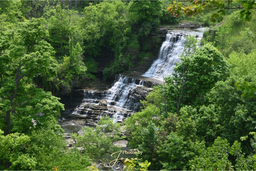
Terraced
A terraced waterfall is one where several segments of the waterfall are separated by "Terraces" or level steps. For example, Albion Falls is a Terraced Classic Cascade.
Complex
Usually applied to cascades, a complex cascade usually refers to one which alters the direction of its flow during its descent, or has some other noticeable deformation.
Talus
Usually applied to cascades, talus is detritus that has been washed down by the force of the flow. A talus cascade is one where the substrate over which the cascade flows is composed mainly of rocks that have been washed down by the flow of the cascade, rather than bedrock.
Washboard
A cascade where the bedrock is usually a form of shale that has eroded to form many very small steps, similar in appearance to a 'washboard'.
Manmade Monstrosity
A waterfall that is the result of human intervention, usually (and invariably a futile venture) to prevent erosion.
Flow
Seasonal
There is flow during and after the winter melt and during and after heavy rain, otherwise flow will be minimal at best.
Very Seasonal
There is flow for two or three days a year when the thaw is at its peak, otherwise nothing. Waterfalls that fall into this category have generally been left out, unless I was lucky enough to be there on the right day and managed to capture the occasion.
Year Round
There is generally flow all year, however this may diminish in summer and autumn. Flow at waterfalls is dependent on flow in the source. Very few falls have good flow after six weeks of drought.
Watershed Temperature
The classification of cold, cool, and warm watersheds is based on summer stream temperatures and groundwater influence, which directly impact oxygen levels, biodiversity, and fish habitats. These classifications are not strictly standardized but generally follow temperature thresholds.
Coldwater
These have a mean summer temperature below 19°C. They are most likely to be groundwater (spring) fed, fast-flowing and heavily shaded; leading them to be consistently cold throughout the year and to have flow throughout the year. They have the highest capacity for dissolved oxygen, supporting the greatest biodiversity, however, they are highly susceptible to climate change and land-use changes that remove shade from the banks of the watercourse.
Warmwater
Warmwater systems have a mean summer temperature above 20°C. Generally, their source is run-off, mainly from agricultural and rural land and roadside ditches. In general, they are shallow, slow moving watercourses with less shade. The increased temperature of the flow reduces the capacity for dissolved oxygen and increases the risk of growth of bacteria and fungus. They also frequently dry up in summer, making them attractive to far fewer fish and invertebrate species, hence a much narrower biodiversity than coldwater systems.
Coolwater
These sit in the 19-20°C range, between coldwater systems and warmwater systems. The water is not capable of supporting as wide biodiversity as coldwater systems, though wider than warmwater systems. They are generally the result of land-use changes along the watercourses of coldwater systems, which is why it is growing increasingly important to protect coldwater watersheds from human impact, such as over-development of the land.
What's In a Name?
The names that are used on this site are the 'commonly used' names, that is to say the name by which most local residents refer to a waterfall. Where this differs from the 'official' name (or there are other names in use) these are given as 'Other Names', along with who refers to the waterfall by that name. Search takes these other names into account.
Trails
Where available, trails are shown on Waterfall pages, Parking pages and Park pages.Types
Several different types of trail are shown:- Return - the trail goes somewhere and stops and the only way back is to retrace your steps;
- Through - the trail goes from a defined start to a defined end. A through trail is also a return trail if, instead of using alternative transport at the destination, you choose to retrace your steps;
- Star - the trail goes to a central location and multiple return trails branch from that central location;
- Loop - the trail ends at the same location where it starts but there is no retracing of footsteps.
Length
Lengths of trails are approximate. They are recorded by the same app that records the actual route, running on a GPS recorder on a phone, and are the sum of the lengths of the segments that make up the trail. Additionally, because trail segments get re-used, it is not easy to determine whether a user will walk over the same segment once or twice.
For Return and Star trails, the trail length is double the sum of the lengths of the segments as most segments will be walked twice - out and back. For Through and Loop trails, the length is not doubled. So, for excursions from a route trail, the length of those excursions is only counted once.
For these reasons, trail lengths should be taken as a rough guide only, but in 99% of cases are close enough. If you are fine walking 2km but will die horribly if you walk an extra 100m, don't take any excursions from a loop trail that has a length of 1.95km.
Search
Tolerance/Limit
"Tolerance" is the amount of space around a feature that classes as a "hit" on that feature. This is used to make hitting a feature easier on mobile devices. The downside of this is that by zooming out, a hit could return a very large number of features, therefore the number of features that are returned on a successful hit is "Limit"ed, so as not to "break the intronets". In the event that this limit is exceeded, the limit will show 'feature limit'/'features actually hit'.
If you feel that a tap on the screen should have returned a particular feature but it did not, try zooming in and trying again.
Other Stuff
Just Because...
We chase waterfalls because we enjoy it and it's fun, so, here are some definitions of dubious provenance (Jona)...Cataract
(n) Waterfall, from the greek Καταρράκτης (waterfall).Cataractology
(n) The study of waterfalls, from the greek Καταρράκτης (waterfall) and λογίᾱ (study of).Cataractologist
(n) A person who studies waterfalls, see cataractology for etymology.Cataractophilia
(n) The love of waterfalls, from the greek Καταρράκτης (waterfall) and φιλία (love of).Cataractophile
(n) Lover of waterfalls, see Cataractophilia for etymology.Cataractophobia
(n) Extreme or irrational fear or dislike of waterfalls, from the greek Καταρράκτης (waterfall) and φόβος (fear or morbid fear).
Cataractophobe
(n) Person with an extreme or irrational fear or dislike of waterfalls, see Cataractophobia for etymology.
Cataractophobia is a terrible condition and it is unfortunate that it is all too frequently used as an excuse by persons who believe that they have better things to do (eg playing video games or doomscrolling) than getting out into nature, chasing waterfalls.